Copy the Principle, Not the Exact Thing
The most frequent reason women over 40 leave the salon disappointed is that they brought an editorial photograph of a model to their appointment and asked for that exact haircut down to the millimeter. That reference photograph was captured under studio ring lights, on a model whose hair follicle density, growth direction, skull shape, and cowlicks are entirely different from yours. Attempting to copy a haircut verbatim almost always fails because haircuts are architectural structures that must be custom-built around your personal anatomy.
When studying inspiration for a trendy long pixie crop for women over 50, look past the model’s age, bone structure, or hair color, and isolate the underlying mechanical principle that makes the cut work. If you admire a dramatic crop on a model with thick, straight hair, look at how the stylist used an undercut to clear away bulk, and discuss with your stylist how that same principle can be adapted to give your fine waves root lift. Once you understand the mechanics behind a cut, you can work with your stylist to tailor it to your unique hair biology and daily routine.
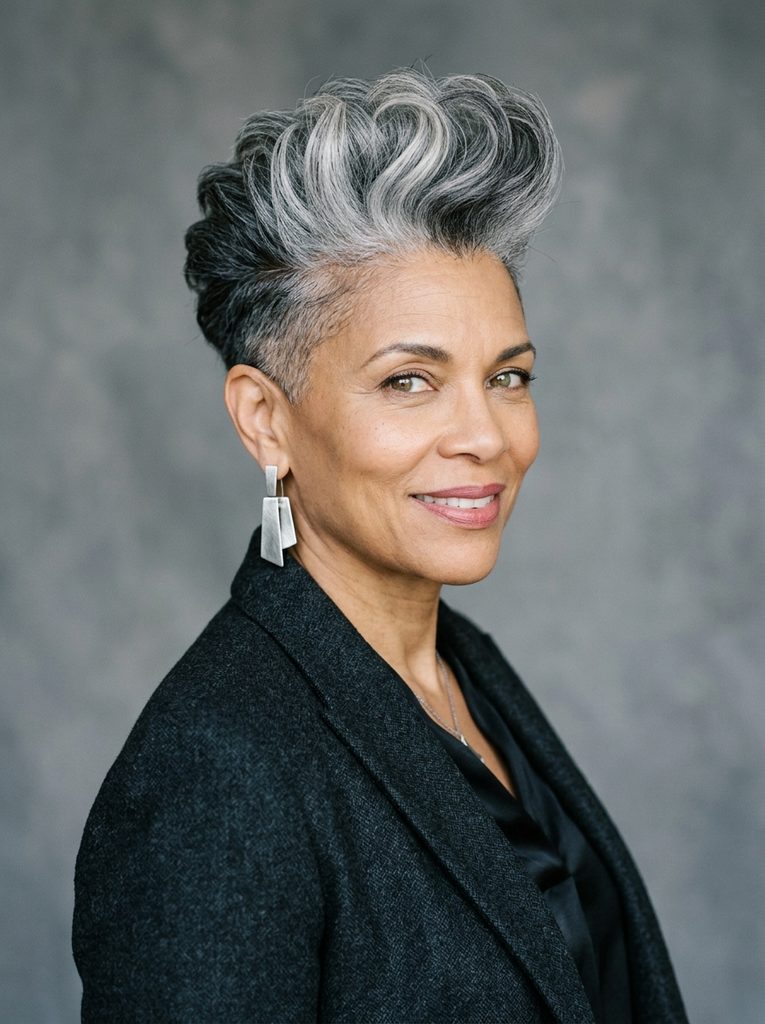
| Instead of Copying This | Borrow This Principle |
|---|---|
| A razor-sharp, zero-guard skin fade | Ask for a soft, scissor-over-comb shadow taper that preserves soft, velvety hair coverage. |
| A heavy, blunt-cut horizontal brow fringe | Request an airy, point-cut micro-fringe or diagonal veil that softens brow lines. |
| A stark, pin-straight disconnected canopy | Incorporate soft, slide-cut interior layers that allow your natural wave to bend. |
| Shaved, graphic temple designs or etchings | Use subtle diagonal sideburn shaping to contour cheekbones and clear space for glasses. |
| Flat-ironed, glass-smooth styling | Emulsify a dime-sized amount of air-dry texture balm for natural, touchable separation. |
| A round, teased, and lacquered crown | Cut short internal graduation shelves beneath the crown to physically prop up the top hair. |