Copy the Principle, Not the Exact Thing
The most common salon heartbreak occurs when a client brings a high-gloss photograph of Helen Mirren, Jamie Lee Curtis, or Robin Wright to their stylist and demands that exact cut. Direct duplication almost always fails—not because your hair isn’t beautiful, but because your cranial anatomy, scalp whorls, hair thickness per square centimeter, and face shape are entirely unique to you.
When you see a pixie cut that makes your pulse race on an editorial page, look past the model’s jawline or hair color. Interrogate the mechanics of the image:
- Is it the dramatic height at the back pushing the hair forward?
- Is it the deliberate balance between an exposed ear on one side and an elongated cheekbone-skimming fringe on the other?
- Is it the transparency of the fringe that keeps the face open?
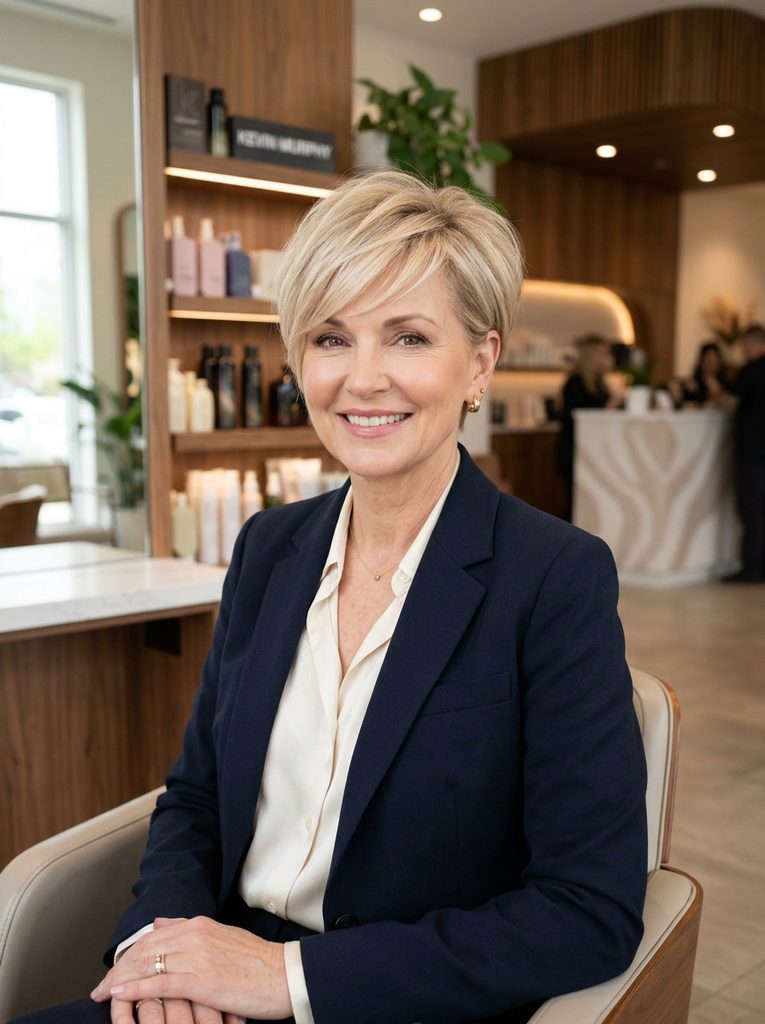
When you extract the underlying engineering principle, you hand your stylist a creative brief rather than an impossible assignment. They can then translate that structural logic into something that flatters your hair type, bone structure, and morning schedule.
Use this translation guide before your next salon appointment to identify the actionable principle behind your favorite looks:
| Instead of Copying This | Borrow This Principle | How to Apply It in the Real World |
|---|---|---|
| A dense, solid sheet of bangs that covers the entire brow | Diagonal Negative Space | Ask for slide-cutting along the fringe to reveal small slivers of forehead, preventing the cut from looking heavy or juvenile. |
| A skin-tight, clippered military fade on the nape | Clean Neckline Graduation | Request a soft, tapered scissor-over-comb finish that hugs the natural neckline curve without exposing bare scalp. |
| An ultra-tall, teased crown silhouette | Directional Back-to-Front Weight Distribution | Ask for shorter internal layers behind the crown that act as an invisible shelf to naturally lift the longer top sweep. |
| High-gloss, silicone-slicked red carpet styling | Separated Matte Texture | Skip high-shine serums and finish your cut with a dry clay paste or texture spray for a touchable, modern finish. |
| A rigid part line scored down to the scalp | Soft Disconnected Parting | Part your hair using your fingers in a zigzag pattern rather than a comb, avoiding harsh, widening scalp visibility. |
| Thick, blocky hair around the ears | Internal Spatial De-bulking | Ask your stylist to point-cut or carve out small channels behind the ear to allow hair to lie flat without looking thin. |